Showing posts with label childhood. Show all posts

03 August, 2024

Chewing gum

Many years ago, I went to pick up Julien at the kindergarten. He said he was really hungry, so I gave him two pieces of gum to chew. (I do not remember if it was the first time I gave him gum.) I was hoping the gum would keep him quiet until we got home.

And it worked! He didn't make one peep the whole way home. When I went to take him out of the children's bicycle seat, I flew him around in a circle before putting him on the ground. Instead of looking happy, he looked distraught.

When I asked him what was wrong, he cried out. The gum was now stuck together. All the way home, he had chewed one of the pieces of gum on the left and the other on the right. He didn't know they were meant to chew together. No wonder he wasn't able to talk to me.

I gave him a big hug and brought him upstairs for a snack.

21 January, 2024

I am... not an old hippie


Many people think
Baby boomer means hippie
I wish it were so.

As someone who spent all my teenage years in a ballet studio during the day and many evenings and was in love with classical music, jazz, and Gregorian chant, I find it puzzling how many people assume I am an old hippie. I was 12 years old when Woodstock happened. 

And yes, my two sisters were more in love with the whole psychedelic vibes of that time, but they did this covertly and never let on to their far too-uncool younger sister.

30 August, 2023

When adults are not in sight

Close my eyes and wish
Childhood laughter, much glee
Lightness of being.

(This post is part of my "Growing Up & Growing Old" project.)  

16 March, 2021

Humpty Dumpty

humpty dumpty
"Humpty Dumpty sat on a wall, Humpty Dumpty had a great fall, All the King's horses and all the King's men, Couldn't put Humpty together again."

The Humpty Dumpty nursery rhyme is a mystery to me. The way that I see it, Humpty Dumpty must have been royalty of sort. I suspect he was the brilliant spoilt youngest son of a very pompous sovereign. The problem with the Humpty Dumpty’s rhyme is that the real lesson or moral of the story takes place before he climbs up onto that wall. 

The moral of the story is not about falling or how useless the king’s men are. No, the story is about how Humpty Dumpty got up on the wall in the first place. What sort of life did he live that he came up against the wall? Why was the wall there? Was he a dreamer? A rebel? Was he running away from stifling sovereignly duties?

I knew a Humpty Dumpty in my childhood. He was an architect, possessed with grand visions about the importance of architecture and his own brilliance. He possessed a fine appreciation for art and nature. He was the first person I met, who felt there was absolutely no separation between the two. Art was nature. Nature art. 

His family and mine were befriended from the time of my birth. Life was fascinating when he was around. For example, he would take us children out digging for Arawak and Carib Indian artifacts. We would be out under the hot afternoon sun, getting mud under our nails, fire-ant bites on our legs, all the while trying to pry the pottery shards from the grips of the earth. He would transport us back hundreds of years to the time when the Arawak and Carib Indians populated the island. 

Then he would reprimand us severely if we whined about heat or thirst or hunger. We were explorers, archaeologists, and not sissies. He could get incredibly angry about things we couldn’t comprehend. 

In the evening, having changed into more formal attire, he would charm a room full of dinner guests. He would talk art, history, and politics. It did not matter what the topic of interest was, he knew everything there was to know. Or, at least so it seemed to me as a child and young adult. 

Eventually, I began to see the wall on the horizon of his life. His furious intelligence turned to fury. His magnificent visions became hallucination. He started to climb his wall built with bricks of egotism, self-centeredness, megalomania, dementia, schizophrenia, and Alzheimer. Tragically, all the King’s horses and all of us king’s men, we couldn’t put him back together again.

(This is a blog post from 2008 that I am republishing under my Growing Up and Growing Old project)

08 September, 2011

The Art of Living Life Barefoot

There are two types of sailors. Ones that see the deck is wet and carpeted with sharp objects and wear the appropriate footwear. And those who slow down and get the feel of the danger by being barefoot. I was raised in a sailing tradition of the later.

If we put shoes or boots on while on-board, it took away a vital means of sensory perception. Instead of letting our feet help us “see” our way across the deck, we would blindly bump our way around.

The reason I am babbling on about this is because I spent a good part of the night (sleeping badly at the moment) thinking about the art of living one’s life barefoot. How there are whole groups of people or cultures that go through life so.

My early childhood in Venezuela and Grenada was completely barefoot. In my later childhood we were always so at home. We even tottered down the frozen driveway in deepest winter barefoot to dig the newspaper out of the snow bank without shoes. And there were the blissful summers where our feet never touched anything but stone, sand, grass, and hot pavement of the roads coming home late in the day.

Then nearly thirty years ago, I moved to Germany. A culture that doesn’t embrace bare feet. I’m sure you’ve seen the German tourists that wear sandals with socks. This just shows how clearly they don’t get the concept of going barefoot.

Ok, in the privacy of their homes, or while sitting in their gardens… yes, you can get a glimpse of folks here wiggling their toes. But that is about it.

I’m not saying this is wrong. It is just other. Not bad other or good other… just other.

Living here so long has changed me in many ways, but in no way as much as in this matter. I see American tourists walking through airports wearing flipflops, and shrink into myself. All those bared toes… in public… how inappropriate. I look at teenagers wearing bare feet in the cities during a hot summer day and think, spittle, grime, and dog poo.

Oh no, I’ve sold out! How could that happen? Could it be possible to retrieve that feeling a naked innocence of times past?

Would I have to take off my soft and warm slippers this cold rainy morning to do so?

09 July, 2011

Homage to my Umbrella IV

umbrella01 red
There are no childhood memories more filled with sounds, smells, and touch then those summer days spent near water. Timeless moments with sand between my toes. Salt from the sea caked in the crevasses of my skin. The feel of the sun hard upon my scalp. Digging. Digging. For gold. For China.

Stopping briefly to run into the water. Quickly, secretly, I flip my bikini bottoms down so the cakes of sand can dissolve away from between my legs. Quickly. Joyfully. I dive deep down into the coldness. My breath sucked away. I struggle to surface. An intake of breath a triumph. The wind slaps waves into my face and up my nose.

Rushing back to shore, I plop back down in my hole to China.

Such memories are divine. They transport every cell of my body back in time.

25 March, 2011

Need to inspire

Nichole Pinkard from New Learning Institute on http://vimeo.com">Vimeo.

A friend recently asked me if I would hold a series of mini-workshops for youths and their parents concerning media literacy. I don't know what it is like where you live, but in Germany, there tends to be an enormous amount of discussion about the dangers of media and very little celebration of its potetial to influence our children's ability to develop their communication and problem-solving skills.

Nichole Pinkard speaks persuasively about how imperative it is for us to inspire our children toward learning a complex set of learning skills they will undoubtedly need in the future. Can you imagine what it would be like to have access to the Digital Youth Network program (especially library part) she discribes?

Mimi Ito from New Learning Institute on Vimeo.

Equally, Mimi Ito looks at the questions of "Why do we assume that kids socialising and playing is not a side of learning?" and "Why do we assume that schools can't have a spirit of entertainment and play as a part of what they are doing?". Her group has done extensive research about "friendship driven participation" and what short of beaviour and learning processes the children are involved in. They have also looked at all the things kids do beyond just chatting with each other after school.

She summarises succinctly the gap that exits between the generations. How the older generation places very little value on the time their children spend before the screen. How they even believe the internet is hostile to learning. What she says is must do is  to differentiate between friendship-driven activities and interest-driven activities. If we lump them all together we miss the opportunity to enter into a conversation with our children about something that has a huge potential to teach them important skills.


27 February, 2009

Childhood Adieu

A friend of mine, Marie, was visiting today from Denmark. Marie came to Luebeck with her partner and two small girls. This morning, I suggested to my thirteen-going-on-fourteen-year-old daughter whether she’d consider going through her old dolls and passing on something to little Tira and Lina. So, before she went off to school she put her choice of dolls in her beautiful hand-carved wooden doll bed and told me in passing, “We might as well give it all to Tira”.

under_bed

I looked at the dolls; each bought at different times throughout my daughter’s younger years, and became quite weepy. “You sure you want to do this? Maybe you would like to give them later to your own daughters”, I asked her as casually as I could muster. She gave the impression of being so worldly as she dismissed this idea, telling me that she is like me, not at all sentimental about such things. She said that since she didn’t get anything from me from my childhood, she was going to be like that later as well.

What she didn’t know was the existence of my double standard system. Even if I don’t feel connected to things from my pass, it doesn’t mean that I am not connected to things from her pass. Does this make any sense?

05 January, 2009

Ridiculous, but still...

Going through Huffington Post today and noticed a link to a slideshow of the Obamas' daughters attending their first day at school. I didn't click on the page. I thought, even though this might sound ridiculous, I am not going to be one of the millions and millions of people robbing these little girls of their right to a childhood far from the maddening crowd. What would happen if no one paid attention? What if no one looked at the photographs, or no one read the articles? Would the cameras disappear? Woudl the journalists turn to more pressing matters? It's just a thought.

18 December, 2008

Tchaikovsky’s The Nutcracker

snowball03

My late childhood and teen Christmases were spent dancing various rolls for The Nutcracker at the large theatre in Montreal with Les Grand Ballets Canadiens. We started rehearsals in September. We had our normal daily course load, as well as extra rehearsals, which meant that we were at the studios All The Time. It also meant, I suppose, that I heard the music thousands of times.

The performances started about a week before Christmas and carried through with matinées and evening performances from Christmas to New Year’s Day.

As to the roles I danced, just about all except the solo roles. When young we got to play “the children” and we worked our ways up to “the angels”, “the lambs” (Les Grand Ballets Canadiens had a storyline twist to their version), “the snowflakes”, and “the waltzing plums” … actually, I seem to forget what those roles last corps de ballet were; I doubt we were the snowflakes or waltzing plums.


For many years, anytime I heard even the opening notes to any of the musical pieces of The Nutcracker, I’d run in the opposite direction. Yet, I love this video because it sort of treats Tchaikovsky’s music with sound portions of gusto and irreverence. Tchaikovsky would turn in his grave. And that thought makes me smile.

25 November, 2008

Postcards from Past Lives: Grade 7

schooldays_postcard

Dear Lilalia,

Ugh! Seventh grade! Can there be anything worse than being in Mr. Tournier’s 7th grade class? Mr. Beer Breath Tournier. The class where all the delinquents (children with behavioural problems) or “retards” (children with learning disabilities) are in.

The school thinks you cannot read or write, just because you cannot read out loud with fluidity or spell correctly. It is strange that they think this, since you spend all of your free time reading. You are a member three libraries, for Pete’s sake.

Don’t despair. You are not a “retard”. You just are dyslexic. They don’t know about dyslexia in your school yet.

It will take another ten years before another teacher tells you about your dyslexia. So, scrape through high school. Go off to dance. Wait a few years before you return to your studies.

Just so you know, better days are ahead.

Love,

the older lilalia

14 October, 2008

Early Morning

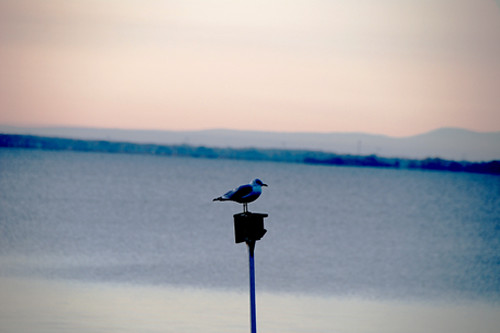
seagull

(photo taken by my son down by the lake near to my sister's home)

There is fog out this morning. The occasional car driving by is muffled in its early morning secrecy. Off to work. Back to school after the Thanksgiving celebrations of yesterday.

The bodies and spirits, are also muffled after all the eating. Thank heavens I'm vegetarian; there is only so much potatoes and veggies one can eat. It was a lovely and enjoyable fête.

The gods willing, we are off to visit with friends today. The children, when they were small, really enjoyed being together. It will be interesting to see if a commonality remains.

12 August, 2008

Vultures Eyes, Lucky Nuts

My two children have come and gone again in a whisper of time.

My son was in Montreal for ten days: to keep his grandmother company after the death of her brother and to help my brother and sister in various practical ways. He came home from Montreal yesterday, four hours late and with no luggage. He had a shower. I made him a meal. He packed another suitcase with what clothes were left in his cupboard. Then he went off kayaking with his father and sister on the Poland Ukraine border.

My daughter arrived back four days ago from a two-week trip with friends to Gran Canary. Tonight she went off with another friend and her family to the west coast of France. Last year she had trepidation to travel to Montreal alone with her brother. One year later, she has become fully a teenager and revels in her independence. It is exceptional. It heart-breaking.

I tell you that I am proud of their self-reliance and trust in living life’s adventures. I am also not doing too well at showing this pride gracefully. There is a Squirming Wailer in me that takes an effort to dampened down and doesn’t let that stalwart matriarch shine, as she deserves to shine. This is unfortunate, since, when it comes to a joy of travel and an ease of preparation, my children take after me, which is actually something to rejoice. For those of you who know my husband, you know what I mean.

There were two separate instances yesterday and today, when my son and daughter were doing their packing (on their own), they came into the living room, and when I asked them how they were doing, they each answered, “Nearly finished. I just need the lucky nuts.” My heart tripped each time. For, they were referring to a custom I’ve practiced for the last thirty years or so.

After storms, on the beaches of Grenada, it is possible to find a nut that is locally called Lucky Nut, Vulture’s Eye (the brown speckled variety), or Donkey’s Eye (the grey variety). This nut is reputed to bring seven-years of luck when you rub it and make a wish. Every time I walk on a beach in Grenada, I look along the tide line of debris to see if I can find such a nut nested there. The nuts are supposed to float up from the Orinoco River in Venezuela with the tides.

This is all lore from my childhood and yet, it pleases me to place one lucky nut in each piece of luggage whenever we travel anywhere. I infuse each nut with prayers for a safe and pleasant journey. And, mercifully, our travels have been plenty and pleasurable.

The fact that my children wish to carry on this tradition of their own volition, makes me smile tonight, when actually I feel rather melancholy. Safe and pleasant journeys, children of mine.

P.S. This is my 777th post. A Schnapszahl in Germany... lucky number.

04 June, 2008

Internet Safety VI

(This is the second to last article in this series.)

It’s been fun to write about how parents and educators can act as leaders in our children’s use of digital media and the Internet. Today, I am going to write about Internet-safe practices for the 10 to 14-year-old age group.

This is not a topic that I am comfortable with, for I have no pat answers, I don’t feel that I can make any sweeping statements (usually love those), or that I can give advice that might be applicable to the mainstream. It is a situation though that is very near to my heart and with which I am currently struggling with. For, you see, I have a thirteen-year-old daughter who is challenging my parental wisdom and skills in a manner that my eighteen-year-old son never did, when it comes to wanting free access to the Internet.

My daughter is more challenging than her brother, just because my son didn’t spend any time in the Internet until we got a DSL connection at home about 2 ½ years ago. There is also a difference in their personalities that contributes to the situation. My son is a very reserved and private person when it comes to verbal communication (a diplomatic way of saying he doesn’t talk much). I tend to say, he is an active, but silent participator in our family unit.

My daughter is just the opposite: an active and vocal contributor to our unceasing domestic chaos. Her interest in the Internet is influenced by her older brother, fellow classmates, friends, and, to a lesser extent, her parents. Up until about six months ago, these Internet activities were:

  • The occasional YouTube session of watching “Who’s Line is It Anyways?” (You have to understand that we don’t have a television in our household, but embarrassingly, we own six computers.)
  • Playing (wasting time) online games for her one-hour gaming allotment (3 days/week). Her favourite sites were (online J&R games, zefrank programs, and the stardoll.com site).
  • After she turned twelve, she was allowed to play one hour of WoW (World of Warcraft) once a week. The first six months or so, she could only play in accompaniment of her father or brother. This was a precaution we took because the “tone of voice” on the game chat between the players can get nasty when new players don’t play well and cause their group to lose a game challenge.

The time she spent in the Internet was restricted, the content discussed or approved. She also, occasionally needs to research information for school homework, but that is so minimal it hardly bears mentioning.

About six months ago, my daughter asked us whether she could set up a profile on a national high school student community: sort of like Facebook, but only for 12-18 year olds. No adults are allowed. They also need an email address to use the site.

I wasn’t so thrilled with the idea. My husband, a WoW fan(atic), was neutral on the topic. He gets the online thing, but not if there is no gaming. His WoW activities have more to do with gaming than they do with social interaction.

So, my daughter and I had to battle things out amongst ourselves. We asked my son to contribute to our discussion, as a neutral, but informed, moderate. These are the guidelines we worked out:

  • She could put a photo of herself on her profile page, if it was in no way provocative (my stipulation)
  • Her profile can only be accessed by her friends (her suggestion)
  • There was a six-month trail period, to see how much time she tends to spend on the site (her brother’s suggestion)
  • Copies of all her emails and message announcements are forward to my email account. I will not read the emails or messages; just register their quantity or frequency (my stipulation)

The reason we created a trail periods, was so that we could eventually talk about the amount of time spent on the site. This is because her brother thinks the only real risk of being a member of this site, is the amount of time you waste. One or two of his friends spend hours every day doing this.

I stipulated that her emails and message announcements be forwarded to my email account for two reasons. First, it is a matter of trust. I am trying to trust my daughter. She’s trying to trust me. I’m trying to live up to her trust. The emails come through my account, I register this fact, and then I throw them unread in my trash.

Secondly, it has to do with the potential danger of my daughter encountering a perpetrator or bully. A friend of mine, who worked for many years in a shelter for abused women and children, once told me that the media was fond of supporting the myth that most perpetrators are strangers. When the reality is most often otherwise; most victims know their abusers. Certainly, the friends and acquaintances I’ve known who suffered abuse or rape nearly always fell into the later group.

So, my reasoning for forwarding the emails is, if my daughter is running into a dangerous situation, maybe just maybe, she’ll tell me, or maybe I can see the signs of obsessive activity though an increase in correspondence, or maybe, hopefully, she will be able to avoid the situation right from the beginning. I just don’t want her to feel alone with the situation.

Also, I do wonder whether setting up a system of checks and controls has other pedagogical uses. I really have no idea. This is very dark swampy ground I’m navigating through. I can’t imagine what it must be like for my daughter.

P.S. Thank you to my daughter, for reading this article and giving me her permission to post it.

02 June, 2008

Internet Safety V

Much to the contrary to popular practice, media literacy is not acquired by sitting hours (days, weeks, months) in front of a television screen, or computer monitor playing computer games, or creating a profile on Facebook and collecting “friends”. It is about interaction, communication, and presentation. It’s about creating content and discussion. Here’s a video, that admittedly goes too far in making it’s point, but that is British humour for you:

In my childhood, literacy was about learning to read and write. If I were to define these activities in our children’s world, I’d say that media literacy is about consuming and creating: consuming information and creating content. As parents, we have the responsibility to supervise and encourage our children to participate in both activities. When they are young (3-10 years), it is more important to stress the creative direction (i.e., creating content). Later on, the consuming/informing part will grow in significance. But hopefully, not to a degree that it overshadows the creative part.

Last Friday, I held a lecture at the Universtity of Kiel about this topic to teaching students. One of the presentations concerns storytelling methods, techniques, and technologies. My message to parents and educators is to see the process of creating content as just storytelling. A skill our children very much need.
Storytelling is, for most young people, best told visually, orally, or in movement or dance. Only a small percentage of people on this earth, can write down their stories on paper with the same beauty and fluidity as they can tell the story through other means. It is unfortunate, that our schools still concentrate highly on written text. It is, of course, vitally important for our children to learn to read and write. I am no disputing this. I just think that we should offer our children more opportunities to explore and express their world through other means.

There is a wealth of Wed 2.0 applications, tools, and services for free or for a minimal charge. For those of you wanting to know about the range of possibilities, I’d suggest starting here:

The best starting point is commoncraft videos
Other videos you can find in TeacherTube or YouTube
Good educational blogs (1, 2)
RSS links to various tools (1)
Online Dictionaries (1,2)

The reasons for doing this can be found in what all of these leaders of education are saying:

If you wish to know what sort of projects you can make with your children, write me an email (address in sidebar). Include your children’s ages, interests, school level, and present use of media. I’d be happy to send you some suggestions.

25 May, 2008

Internet Safety IV

Many (translate: most) of my friends and the teachers I know or work with, throw their hands up when it comes to becoming proactive and leaders in helping their children become media literate. They find this notion daunting.

Here follows the three main arguments I hear (over and over again) about why they remain inactive and my counter arguments:

1. Too much information

“There is just too much information out there, I don’t even know where to start.”

Try to imagine the situation where you learn to read in a classroom setting without the help of books and then you enter a public library for the first time. What would you do? Walk away because you are overwhelmed, or seek out the help of the kind and knowledgeable librarian? No one is asking you to be instantly savvy, rather, as a parent and educator, you just have to tread wisely and find someone to guide you.

I was fortunate to “meet” Will Richardson and David Warlick a few years back. They are two educators whose passion, wealth of experiences, and musings, inspired me to reach beyond my initial scepticism and fear to venture out into the wide world available to me through my computer. Through them I “met” other people from various professions, who are exploring exciting and interesting ideas. I can say without a doubt, that over the last five years, I have probably learnt more than I have at any other time since becoming an adult; in part, through the guidance of people active in the Internet, but also through my own humble learning experiences.

2. Too little time

“I just don’t have the time.”

Make time. This is important. There was a time, if someone said to you, “I don’t have time” it was a brush off. A rude brush off. The question we have to pose ourselves as parents is whether our children, internally, interpret our “no time” lifestyle as a brush off or disconnect. Our children are feverishly establishing identities, friendships, job profiles, gaming buddies etc. online. Not knowing personally about the pitfalls and rewards of such activities is tantamount to neglecting our parental responsibilities.

3. Too much crap

“There is just so much crap out there, I couldn’t be bothered wasting my time and energy on it.”

Have you been in a large bookstore or music store recently? Not only is there a lot of crap on the shelves there, but also a good percentage of the content is probably not to your tastes or doesn’t speak to your interests. The whole joy of the Internet is the fact that you can find the mainstream, the eclectic, the good (and I mean veryvery good) and the bad (even, sadly, the criminally bad) right in front of you. In the end, you are responsible for the quality and quantity of the information you read, the activities you participate in, and the people you communicate with on the Internet.

To be continued…

22 May, 2008

Internet Safety

While I was in Toronto recently, I had the pleasure to talk with a couple about Internet safety for children and adolescents. L. has two sons who are more computer and computer game savvy than she is. D. teaches media in a middle school in a volatile area in downtown Toronto. They, like most parents and educators, are swimming through muddy waters when it comes to keeping children safe from adverse content and effects of the Internet.

I thought I would spend a few days writing about topics concerning parents, children, Internet safety, media literacy, media use… It has been a while since I’ve written about these topics near and dear to my heart and mind. The conversation with L. and D. has spurred me on.

Overall, I have the impression that there are difference about how the parents and educators feel about Internet safety and children’s use of media in Germany in comparison to the States and Canada. So, keep in consideration that what I am writing is greatly influenced by the culture I live in and my experiences with my own children (now 13 and 18 years old) over the last fifteen years, and the school children I’ve worked with in the last four years.

If I was to write briefly my stance on Internet safety, it would be to say that the focus of our attention and action should be on guiding our children though the Internet and not keeping them safe from the Internet. To do this, we have to build up a dialog and learn to trust our children to use the Internet appropriately. And by dialog, I mean listening as much, or more, than talking (lecturing, warning). By learning, I mean the whole jumble: to experiment, to problem-solve, fall on our faces, and jump in triumphant.

This means learning-by-doing and not just assimilating a critical mass of facts. Thus, the belief that it is essential for each of us, as parents and educators, to learn, experiment, and participate alongside our children. It is by travelling alongside our children, discussing the pros and cons of certain Internet applications that we can slowly develop a trusting relationship with our children.

To be continued…

08 April, 2008

Spiced Apples

sand

My grandmother used to make all forms of marvellous produce with the apples from their apple trees. She would use Spice Island spices from Grenada to transform those tart apples into perfumed wonders of tastiness.

My parents lived in Grenada for many years. (My mother continues to do so.) During, what was called, the Revolutionary Years, the only imported food produce to be regularly found in the shops besides local produce was butter and cheese from New Zealand and apples from Canada.

There was something nicely symmetrical about that fact.

06 February, 2008

Outer Space Cow

It’s raining tigers, vampires, princesses, spies, and other mini-sized Hollywood figures. The school children are out in full regalia, celebrating Carnival. I nearly got skewered by a witch’s broom on the way to work today.

So, here’s a Carnival confession of a negligent mother…

One year, when my son was in first grade or so, he had two carnival dress-up parties to go in one day. The party at his school had the theme, Findus and Peterssen: a series of books about an old man and his mischievous cat living in rural Sweden. At my son’s day care, the theme was outer space.

Other moms were sewing costumes for their children weeks beforehand. I was specialising in procrastination, while they were honing their sewing skills. Two days before the deadline, I had to admit to myself that two costumes were not going to miraculously turn up on our doorstep and so I went to a local shop that sold a variety of costumes.

Since it was so late in the Carnival season, all the good costumes were sold out. The only thing remotely Findus and Pettersen that I could find was a floppy hat made with black-and-white cow patterned cloth with two horns attached. I figured my son could wear this with his black warlock wrap from the year before and… voila, he could go as a Swedish cow.

Later that evening, in a moment of desperation or inspiration, I thought to add some bobbles and copper wire to the hat’s horns. Thus ingeniously, I thought, creating a Hey Diddle Diddle outer space cow. My son was quite sceptical about the metamorphosis of a Swedish cow into an outer space cow, but relented in the end.

Unfortunately, Germans children do not know Hey Diddle Diddle. They do not know about a cow jumping over the moon. They do know though how to tease an outer space cow orbiting in amongst spaceships, astronauts, Martians, and shooting stars.

I’ve already saved up a bit of money to pay for that session on the couch of my son’s future therapy. It is the very least I can do.

05 January, 2008

Shrimp Death

Pam of Nerd’s Eye View used to have the following statement in her profile,

I don't eat four legged animals - it's just a preference, not a political act.”

Which is the sort of vegetarian I’ve been for the last thirty-five years of my life. It is a choice I made as a teenager and I just never got around to changing it.

Since I am the cook of the family, this means that we eat a lot of vegetarian meals. No exclusively; I do cook up the occasional meat dish, but probably only once or twice a month. I rely on my husband and children eating a good piece of meat when we go out to eat in restaurants.

When the children were in day care, they ate meat every day. So, I always assumed they weren’t squeamish about killing animals for meat.

That is until my five-year-old my son practically broke down one dinnertime as we were eating a rice, vegetables and shrimp dish. When I asked him what was wrong, he said pathetically, “I don’t know if I can eat this. It makes me sad to think of how they kill shrimp.”

Unfortunately, I think I started laughing. If there is one being on this earth whose death doesn’t make me wince, it is shrimps. Do they even have brains? At least I didn’t express what I was thinking when my son told me about his qualms, which was, “If you think that is bad, just wait until you find out about chickens, calves, lamps, pigs…”