Showing posts with label trust. Show all posts

22 November, 2008

Postcard From Past Lives: Deutsch Post

postoffice_postcard

Dear Deutsche Post,

Oh ye of little faith! Just because I lavish a bit of praise on the Deutsche Bahn (German train company), doesn’t mean that my affections and appreciation of your services have waned. In the 26 years since I moved to Germany, you still can deliver a letter anywhere in Germany in a-day’s-time or two at the latest. Not only do you do your normal duties thoroughly, but you also have little German elves working in the backrooms individually handling the following situations:

Wrong or Incomplete Addressed

Taking letters addressed to me with the wrong house number, or “near the electrician shop” written in place of the street name, or my name/ city/Germany written on the envelope, and asking your elves to write my proper address per hand for the postwoman to deliver with only one-day’s delay.

Broken Package Shelter

A package arrives per sea freight with the carton split at all seams and the package contents no longer contained. Your elves gather up the contents, send them to a broken package shelter in Frankfurt, where they are stored in the interim. They write to me with the news of this unfortunate manhandling (which obviously is not their own, but some bully Scotsman in the Orkney Islands post office who didn’t give a hoot) and then send me the remains in a new carton with apologies for any inconvenience. At. No. Extra. Cost.

Ramped Vandalism

A vacuum-packed plastic envelope arrives with the burnt remains of a letter I wrote to my mother and sent off to Grenada the week before. My return address, written at the top left-hand corner of the letter, is the only recognisable part of the charred remains. Someone had set off fireworks in the post box during New Year’s Eve celebration, and your elves wanted me to know that the letter wouldn’t arrive.

So, please stop sulking and feeling neglected. You are my stalwart friend and I love you to bits and always will.

Your faithful friend,

Ye who believes in elves

31 October, 2008

This Year’s Word: Trust (3/3)

(This is the last post of this series.)

Until recently, I thought of childhood memories as pieces of a vast puzzle that are neatly stored in my brain. Since my brain’s workings are complex, so is that memory puzzle complex. Often, I’ve felt defeated by how little I remember of my past and how little I use the memories to help overcome day-to-day challenges. Then, a short while ago, a dear friend of mine told me something that pierced my confusion.

She told me about how memory resides in every cell in our bodies. When we remember an incident, for example, we recreate or relive the experience all over again on some cellular level. This concept is not new, but the way my friend describes cellular memory, acted as a key to opening the door to new thought.

The following presentation presents these thoughts in context to trust:

Cellular Trust
View SlideShare presentation or Upload your own. (tags: trust)

I hope you have enjoyed these reflections. They’ll probably be the last for a while, for I’d like to get back to doing more storytelling.

29 October, 2008

This Year’s Word: Trust (2/3)

As I mentioned in the last post, it became evident that it was time to go off and find out what Trust actually is, from both a theoretical, as well as, a practical point-of-view. I gave myself this year to study the scholars, to converse with friends, and to participate in solitary contemplation about the meaning of trust, and its importance in life.

The Oxford dictionary defines trust as a firm belief in the reliability, truth, ability, or strength of someone or something. How do I know whom I can trust? How do I decide, not only to what extent I can trust someone, but what this person can be entrusted with?

The easiest answer to the question, “How do I know whom I can trust?” is to ask, “Who do I trust at this moment?” and “Who have I trusted in the past?” If the list of people you trust presently contains the same names as the people you have always been able to trust, you’re probably one happy trooper.

In my case, I tend to trust people near-and-dear to me with information or in situations where I need a shoulder to cry on, or their truthful opinion, or their knowledgeable judgment. Sometimes I have trusted wisely, at other times very unwisely. What I have learnt is that even though it would be wonderful if we could trust our loved ones with everything, it is not always prudent to do so.

This is because trust has many dimensions. First, we must find someone who is equally committed to the outcome of the situation we are entrusting them with, as we are. I trust my husband with my worries about my impending unemployment (my work contract is coming to an end in two months’ time), not only because he loves me and cares about my concerns, but because our financial livelihood is dependent on my contribution.

Secondly, the person we trust has to have the required skill or ability to carry through that which we are entrusting them with. It is not prudent to trust someone with my life-savings, if they’re always living on the brink of financial disaster. Lastly, there is always an element of unpredictability, or risk, when we trust someone to do something. If there weren’t risk involved, then we wouldn’t be entrusting them, but just instructing or informing them.

When I reflect back over the last ten years on situations or persons who have failed to live up to my expectations, I asked myself why did they fail: lack of commitment or lack of skill? And, as it turns out, it is nearly always the lack of skill that is the central cause for the failure. Not only their skill is lacking, but also my sense of judgement. Why would I trust someone with something they have no ability to succeed in?

Going back to the Oxford dictionary definition of trust (a firm belief in the reliability, truth, ability, or strength of someone or something), the question is where does that firm belief come from? I can only conclude through experience. Since childhood, I’ve trusted those near to me: my parents, my siblings, and my friends, with aspects precious to my wellbeing. And, the outcome of those experiences becomes memory.

No matter how distorted these memories are, they are all I have to navigate by. Thus, it is important to consider what I remember about these people, particularly their abilities, when I decide to ask them for constructive help and quiet solace. It is as simple as that.

27 October, 2008

This Year’s Word: Trust (1/3)

At the end of last year, the artist Christine Kane wrote in her blog about her ritual of choosing chooses a word to guide her throughout the year, instead of making New Year’s resolutions. She recommended to her readers that we might try this as well. I decided to choose the word Trust to guide me through this year.

The reason that I chose Trust as my word arose from a short conversation I had with a physiotherapist, not long after reading Christine’s blog post was published. The therapist was treating me for tension in my neck and shoulders. She uses a form of massage called Craniosacral, which has helped relieve the tension in the past. It not only works on specific areas of the body, but also on metaphysical organisms. At the end of one session, she tells me she thinks I have difficulties with my kidneys.

According to her, kidneys are sources of energy. They should radiate energy like a warm oven. Mine were hearths of cold ashes. She goes on to explain that in Chinese medicine, each organ is associated with an attribute. Kidneys, apparently, denote trust; did I, she asked, have any problems with trust?

Upon returning home, I made myself a hot cup of tea and asked myself this very question. Surprisingly, I started to cry when I posed the question. And, it became very clear that somewhere along the line, over the last decade, I had lost my ability to trust certain people near-and-dear to me, and, more importantly, I had lost trust in myself, in my ability to overcome existential challenges. It was equally evident, that I had to rediscover this ability.

Yitzhak Rabin said,

If you have the same problem for a long time, maybe it’s not a problem; maybe it’s a fact.”

It was evident that it was time to go off on a fact-finding mission. One whose goal was to find out what Trust actually is, from both a theoretical, as well as, a practical point-of-view. I gave myself this year to study the scholars, to converse with friends, and to participate in solitary contemplation about the meaning of trust, and its importance in life.

There has been much I’ve studied and much I’ve been told. It has been a full year in this concern. Yet, I don’t wish to list the information, but rather I wish to write in the next two posts about two aspects of trust that I have learnt through experience, as well as study.

To be continued...

19 March, 2008

The Ultimate in Nonchalance

Well, the taxi is due to arrive in the next half hour. Nomad Son is not back from school and has yet to pack his backpack or eat his lunch. But, am I worried? Nooooo. The reason this is so, is that my dear daughter, fellow traveling companion, is in her room practicing her saxophone. My husband, stay-behind-limpet, has just placed a hot cup of tea on the table beside me. Is that the ultimate in nonchalance, or what?

I have been intending to write a post about why it is my children are my favorite people to travel with. It is not only that they are such personable companions, they are as reliable as hoot for being reliable, even-tempered, and wry humored. What more could a gal wish for.

Yesterday afternoon, as my daughter and I were talking about what she is to wear on the plane, I suggested she wear some super cute earrings she got for her birthday. The earrings are so fun looking they are bound to bring luck. My daughter objected because they don't match anything she is going to wear in the way of clothes. I felt that wearing lucky earrings is much more important than whether red matches with brown. My son comes in and asks what the discussion is about. We tell him; to which he responded that wearing any earrings while flying is impractical. Then he goes out of the room, only to return a few seconds later, commenting, "Do you realise that this last conversation sums up exactly how the three of us work?".

29 December, 2007

Trust: One Word, One Mission

oldwatch02

Christine Kane wrote an interesting blog post called, “Resolution Revolution: A Better Way to Start Your Year”. In brief, she feels setting up a list of New Year’s Resolutions doesn’t work in the long run. Something most of us suspect is true.

Instead, she suggests that we choose a word to guide us through the year. This word is then our focus and we can take the year to explore the endless possible meanings.

My word for this upcoming year is trust. I am going to reflect, contemplate, and meditate upon the meaning of trust. I wish to find out where or when I lost my trust in myself: especially, the loss of confidence in and reliance on my ability to meet life’s challenges. I plan to read, write, dance, do yoga, laugh, cry, dispute, and discuss about what trust is and rediscover that jewel my spirit once possessed.

10 June, 2007

Sea Eggs Abound

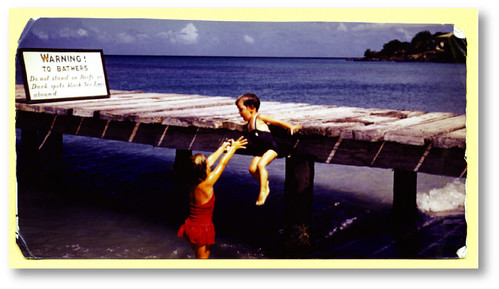
This photo was taken of my oldest sister, Karen and me on Grand Anse Beach in Grenada. I must have been about two or three years old at the time. In the picture, I am leaping off the wharf into Karen’s arms: who is standing below with her arms extended up to catch me.
seaeggs
If you look closely, you can see that Karen is standing in about an ankle’s height of water. this foretells a collision of bodies and not a swooping, swishing, submerging dip in warm seawater.

There is a sign on the wharf that says: Warning To Bathers! Do not stand on Reefs or Dark spots, black Sea Eggs abound.

Even though I truly believe that my life is blessed, and I thank the gods daily for this, there are many similarities between what is happening in this picture and what I think life is all about:

  • be careful whose arms you jump into
  • not all landings run smoothly
  • intrinsically, there is joy in leaping into the unknown even though there are always very real dangers present

When I contemplate this photo, what I see in all of its wonderful graininess is a young girl’s ability to trust; something that I seem to have lost along the way.

As some of you know, the last eight years have been challenging ones in my life. My father’s death marked the start of a long journey into uncertainty and chaos. I wish I could report that I faced the many challenges bravely and gracefully. Kicking-and-screaming-all-the-way would be a better description of my utilised survival strategy.

Remarkably, mercifully, I did manage to learn some excellent lessons along the way:

  • anger and bitterness are cloaks for fear and loss. An important step to ridding myself of anger is to define and mourn what it was that I’ve lost
  • continual and constant success in plotting out my life’s course, is not a measure of a life well lived. Rather, learning to accept the failures as quietly as possible, and with as much dignity as I can muster, makes me the mensch I am meant to be
  • do not stop dreaming
  • learning who my authentic self is, starts with the knowledge that I am enough just the way I am

To be sure, these are all very important essential lessons to learn. Yet, only recently have I come to realise that without trust, I’ll never learn to take magnificent leaps of faith again, as I did all those years ago in Grenada.

This fact set me off searching (googling) for philosophical explanations about just what trust is. (This is one of the first times in my life I actually did a virtual search rather than read books, talk to friends, or just sit quietly mulling things in my brain.) What I came up with was fascinating. For instance, in this one article there were the following points:

“Trust is an attitude that we have towards people whom we hope will be trustworthy, where trustworthiness is a property, not an attitude.”

“One's attitude is conducive to trust if it conveys the following: an acceptance of risk, especially the risk of being betrayed; an inclination to expect the best of the other person (at least in domains in which one trusts him or her); and the belief or optimism that this person is competent in certain respects.”

Essentially, in order to trust someone, you have to believe in the person’s commitment as well as their competence. This explanation might be very obvious to many of you, but it has given me a whole new outlook on what it means to trust.

I, wrongly, believed I could implicitly trust anyone whom I love and care for. This assumption has lead to serious disillusionment. For instance, I trusted some of my family members to manage certain matters since my father died, which they subsequently failed to do. This does not necessarily mean they aren’t committed to our relationship, but rather, they did not possess the competence to manage the matters properly.

I am not sure what this all means at the present point in time. All that I know is that it does mean something. The reason that I sense there is an importance is because I have known people in my life who were trustworthy to the core of their being. My father was one of those.

Today is Father’s Day in Canada and the States. This article is dedicated to my dear father. He was someone I trusted implicitly with my life (literally), and he never failed me once. I hope dearly that my children will be able to say the same of me, when they (finally) grow up and question what trust is.