
30 April, 2010
Ray of Hope
I had a job interview just before Easter. The position is as a teacher in a industry and trade school. I've been invited back for a second interview next Monday. Please keep your fingers crossed.


25 April, 2010
Personality of Things

A while ago, I saw a photograph exhibition in a café in Berlin that was a series of images of the contents of women’s purses. The contents were either neatly positioned in a sort of collage, or just randomly dumped out onto the surface of a table or sidewalk. The images were rather provocative as well as informative. They did seem to speak of the personality of the owner.

I’ve always wondered whether the same thing could be said for what you find on pin boards or how you arrange your office desktop. What do you think?
22 April, 2010
Audience Experience versus Musical Participation
I know a couple that is very active in a charity organisation that brings classical music into people’s everyday lives. They arrange for very talented musicians, mostly master students from the local music conservatory, to play music in concert halls, churches, school auditoriums, hospital wards, prison cafeterias, senior citizen homes, women centers… anywhere people gather, they try to bring music to them.
One of the perks of this couple’s volunteer work, is they get to know many of the musicians personally. A few years ago, three musicians mentioned how they were preparing some pieces for an international music competition. They were concerned that they had only practiced the pieces, but not actually preformed them. So, began a series of home concerts in my friends’ living room.
The next concert is just around the corner (piano and violin) and I am very much looking forward to going. It is hard to describe how magical it is to hear music of such beauty in the intimacy of a living room. There is something visceral, physical, and emotional about the experience. It cannot be compared to recorded music, and not even music performed in a concert hall.
I watched this video today with much interest:
On the TED site, the video is explained as follows:
“185 voices from 12 countries join a choir that spans the globe: "Lux Aurumque," composed and conducted by Eric Whitacre, merges hundreds of tracks individually recorded and posted to YouTube. It's an astonishing illustration of how technology can connect us.”
Initially, I was very intrigued by the idea and even the realisation. Then it started to remind me of some science fiction film, a little eerie, if not unsettling. Then I realised that, from an audience point of view, it just doesn’t work for me. It couldn’t be further from the experience of sitting in the living room with a group of friends and hearing every nuance of a musician’s genius.
The merit of Eric Whitacre’s idea is perhaps in the experience the people performing the piece felt. The opportunity to sing in the comfort of your home and still participate in a virtual concert.
What do you think, would you rather be in that living room as the audience, or in your bedroom as a participator?
One of the perks of this couple’s volunteer work, is they get to know many of the musicians personally. A few years ago, three musicians mentioned how they were preparing some pieces for an international music competition. They were concerned that they had only practiced the pieces, but not actually preformed them. So, began a series of home concerts in my friends’ living room.
The next concert is just around the corner (piano and violin) and I am very much looking forward to going. It is hard to describe how magical it is to hear music of such beauty in the intimacy of a living room. There is something visceral, physical, and emotional about the experience. It cannot be compared to recorded music, and not even music performed in a concert hall.
I watched this video today with much interest:
On the TED site, the video is explained as follows:
“185 voices from 12 countries join a choir that spans the globe: "Lux Aurumque," composed and conducted by Eric Whitacre, merges hundreds of tracks individually recorded and posted to YouTube. It's an astonishing illustration of how technology can connect us.”
Initially, I was very intrigued by the idea and even the realisation. Then it started to remind me of some science fiction film, a little eerie, if not unsettling. Then I realised that, from an audience point of view, it just doesn’t work for me. It couldn’t be further from the experience of sitting in the living room with a group of friends and hearing every nuance of a musician’s genius.
The merit of Eric Whitacre’s idea is perhaps in the experience the people performing the piece felt. The opportunity to sing in the comfort of your home and still participate in a virtual concert.
What do you think, would you rather be in that living room as the audience, or in your bedroom as a participator?
20 April, 2010
Impressive Images and Good Graphics

photo by Olivier Vandeginste
The Big Picture has another series of spectacular photos of Iceland's Eyjafjallajokull volcano outbreak.
My son has been stuck in southern Italy these last days due to the reduced air traffic in Europe. The gods willing, he is making his way home today.

One of the reasons I so enjoy the Information is Beautiful blog is that the author asks the right question and finds the clever answer so often.
David the creator of the graphic above just posted the following information:
"We got our figures wrong on the CO2 emissions of Icelandic volcano Eyjafjallajoekull. Badly wrong.
So we want to apologise.
We pride ourselves on good data and solid information. Despite detailed research and feedback from Icelandic vulcanologists, our figures were out by a magnitude of ten
The volcano is emitting 150,000 tons of CO2 per day, not 15,000 tons."
Even though David made an initial mistake, I still think the corrected image shows how graphics are good for presenting both the big picture and the small details of a situation.
19 April, 2010
Media Production in the Warmth and Comfort of Home
(making of film of a Belgium natural gas advert, the advert is shown at the end of the film)
Stop-motion animation is one of my favourite forms of filmmaking. When I was working in schools, it was the sort of project that children “get” right away. It doesn’t matter whether they are grade 2 students or grade 13 students, you explain the basics and off they go. What is so transparently unique about stop-motion is how a simple idea (e.g. warmth means wool) can be translated into a charming story.
Many children tell extremely complex stories that are often unintelligible to their listeners or readers if they are given free reign of their imagination. Stop-motion storytelling is most effective way of slicing the storyline down.
Take a look at the video above if you want to see how making a very simple stop-motion film allowed this young fellow, Pep, start creating media rather than just consuming it. This is the sort of media production educators (principals, teachers, and parents alike) should be encouraging their students to do.
For a detailed and interesting analysis of what Pep is saying in the film, please go to this post of Henry Jenkin’s Confessions of an Aca-Fan blog.
I’ve published numerous stop-motion animations in the past, so I won’t bore you with any more. If you want to know more about how to make your own stop-motion, please go to this post at makeuseof.com.
17 April, 2010
Everyday Heroes V
Everyday heroes we encounter are important influences on our lives. They have the ability to alter our thinking and, often, even the direction of our decision-making. This post is part of a series I am writing about the heroes I have met.

Name: Ruth
Profession: corporate law
Marital Status: married
Children: a daughter
Place of Origin: Cameroon
How we met:
Ruth came to live in Germany with her young daughter a year and a half ago. She came in the dead of winter. Ruth knew how to speak German and she had conscientiously studied all the facts and figures of this new country she was marrying into. What she couldn’t learn in the warm and wonderful climate of Douala, was what winter cold feels like. How deep damp winter weather can hurt you teeth and bones.
How the winter darkness can sap all the residues of sunny joy stored from childhood memories from the marrow of those bones.
How impenetrable are the blank facades in the faces of her German neighbours.
How confusing is the bureaucratic machinery that every citizen and resident must comply to.
Yet, Ruth proves to have more resilience and resourcefulness and quiet charm than all those dour beings and circumstances that are scattering stones in her way. She has forged loving relationships with her new extended family. She has become mightily efficient at navigating herself around the labyrinth called German bureaucracy. She’s helped her daughter find a place in her new neighbourhood. She has become a wise and kind friend.
What she has shown me:
She has shown an ability to move with assurance in a strange culture. She has show me that even if you are confused and at times desperate, you can’t stop moving in the general direction you see as forward. Whether it is forward or not, is almost irrelevant, just take purposeful steps as best you can.
Name: Ruth
Profession: corporate law
Marital Status: married
Children: a daughter
Place of Origin: Cameroon
How we met:
Ruth came to live in Germany with her young daughter a year and a half ago. She came in the dead of winter. Ruth knew how to speak German and she had conscientiously studied all the facts and figures of this new country she was marrying into. What she couldn’t learn in the warm and wonderful climate of Douala, was what winter cold feels like. How deep damp winter weather can hurt you teeth and bones.
How the winter darkness can sap all the residues of sunny joy stored from childhood memories from the marrow of those bones.
How impenetrable are the blank facades in the faces of her German neighbours.
How confusing is the bureaucratic machinery that every citizen and resident must comply to.
Yet, Ruth proves to have more resilience and resourcefulness and quiet charm than all those dour beings and circumstances that are scattering stones in her way. She has forged loving relationships with her new extended family. She has become mightily efficient at navigating herself around the labyrinth called German bureaucracy. She’s helped her daughter find a place in her new neighbourhood. She has become a wise and kind friend.
What she has shown me:
She has shown an ability to move with assurance in a strange culture. She has show me that even if you are confused and at times desperate, you can’t stop moving in the general direction you see as forward. Whether it is forward or not, is almost irrelevant, just take purposeful steps as best you can.
14 April, 2010
The Moipei Quartet

Photo of The Moipei Quartet
Rafiki Kenya blog post a few days ago included some information about the Moipei Quartet,
“The Moipei triplets Mary, Martha and Magdalene and their younger sister Seraphine form the all girl music group, Moipei Quartet. These talented Maasai girls have very beautiful voices (well trained by their father Nicholas ole Moipei who is also their teacher) and often perform 'a capella' or accompanied by piano only, mostly in classical styles. Some of their songs also bring us a message, like Mbiu ya Mgambo, which highlights the plight of girls in the Maasai community.”
They have just brought out a new CD. Can imagine some of you (that means you, Fee) might like to order it.
I loved this song way back when, when my family and I used to watch John Denver sing it on his television show.
07 April, 2010
Everyday Heroes IV
Everyday heroes we encounter are important influences on our lives. They have the ability to alter our thinking and, often, even the direction of our decision-making. This post is part of a series I am writing about the heroes I have met.

Name: Karen
Profession: librarian
Marital Status: married
Children: two daughters
Place of Origin: Ohio, USA
How we met:
When I first came to live in Germany, all those years ago, it was winter. It was dark and dismal outdoors. Indoors it was lonely. I felt lamed.
Not knowing how to speak German was a barrier. As the only woman in a large department of socially inept engineers, it wasn’t easy getting to know people. When I met an American woman, Karen, whose husband was an officer in the US Army Base down the road from where I worked, my world changed.
Karen was actively immersed in the social and cultural life of the city; unlike many of the officers’ wives who lived very isolated lives on base. She was a member of the Bach Choir, part of the women’s literary society, and active in the neighbourhood community where she and her husband lived on the outskirts of the city.
What made her special was her willingness to (learn and) speak German, as well as her willingness to (learn and) respect the various social norms prevalent to the area. Up until the time I met Karen, I had been struggling unsuccessfully to learn German. And, my attitude towards the mountain of social norms I was being buried under was, “If you could just leave me alone, I’d love to leave you alone.” Karen, in her infinitely gracious and gentle manner helped me to surrender myself to my lot. Through example, she taught me more about how to be happy living as a foreigner in a foreign land than anyone I have met before or since.
What she taught me:
The first way to get to know someone is through language, then shared interests and experiences, and finally, through shared sense of humour and value system. She also showed me that there wasn’t any short cut to get there.
Name: Karen
Profession: librarian
Marital Status: married
Children: two daughters
Place of Origin: Ohio, USA
How we met:
When I first came to live in Germany, all those years ago, it was winter. It was dark and dismal outdoors. Indoors it was lonely. I felt lamed.
Not knowing how to speak German was a barrier. As the only woman in a large department of socially inept engineers, it wasn’t easy getting to know people. When I met an American woman, Karen, whose husband was an officer in the US Army Base down the road from where I worked, my world changed.
Karen was actively immersed in the social and cultural life of the city; unlike many of the officers’ wives who lived very isolated lives on base. She was a member of the Bach Choir, part of the women’s literary society, and active in the neighbourhood community where she and her husband lived on the outskirts of the city.
What made her special was her willingness to (learn and) speak German, as well as her willingness to (learn and) respect the various social norms prevalent to the area. Up until the time I met Karen, I had been struggling unsuccessfully to learn German. And, my attitude towards the mountain of social norms I was being buried under was, “If you could just leave me alone, I’d love to leave you alone.” Karen, in her infinitely gracious and gentle manner helped me to surrender myself to my lot. Through example, she taught me more about how to be happy living as a foreigner in a foreign land than anyone I have met before or since.
What she taught me:
The first way to get to know someone is through language, then shared interests and experiences, and finally, through shared sense of humour and value system. She also showed me that there wasn’t any short cut to get there.
06 April, 2010
Story Missing II
About a half of a kilometer away from the last photo there was a pair of shoes on the sidewalk next to a bank.
 When I saw the shoes, I instantly imagined that they were the pair I took a photo of a few days ago. They could have wandered to their new abode in the dawn hours. I had to laugh at the thought.
Then I realised that this is the time when many proper housewives do spring cleaning (I'm not one of those). So these random pair of shoes could well be what Tine and Ian are talking about in their comments of the last post, just one of many items left out for people to take.

Then I realised that this is the time when many proper housewives do spring cleaning (I'm not one of those). So these random pair of shoes could well be what Tine and Ian are talking about in their comments of the last post, just one of many items left out for people to take.
05 April, 2010
Story Missing
The other morning I work up very early, probably about 5 o'clock, and looked out our living room window. I saw two large shoes placed neatly on top of our electrical connection box. It gave me pause: how did the shoes get there, who did they belong to, what would happen to them now?
 A few hours later, this is what I saw,
 The shoes were gone! What happened? Surely a story that has gone missing. Have you any idea?


03 April, 2010
In the Pines
For her 15th birthday, my daughter requested a gift of an ukulele. She plays the piano and saxs, but this is her first string instrument. I really hope that she can in the future be a part of a group as fun and fantastic as the one above. Do enjoy.
01 April, 2010
April Fools
This is an April Fool hoax BBC broadcasted in 1957 on Switzerland’s magnificent spaghetti harvest. Apparently, it is legendary, but it is the first time I saw it and wanted to share it with you. I excuse myself if you have seen it every year since then.
Happy birthday, Tine!
31 March, 2010
Changing What is on Your Plate
"
How to feed the world ? from Denis van Waerebeke on Vimeo.
This interesting video was made for the «Bon appétit» exhibition in Paris science museum (Cité des sciences et de l’industrie). It was aimed mainly at kids aged 9 to 14, but I must say that this 52-year-old also learnt a fair amount.
As many of you know, the NGO that I work with in Kimilili, Kenya is trying to set up a gardening vocational training program. The program goals are the following,
"Our CBSM Gardening Vocational Training Program teaches women co-ops and youths from our Youth Vision program about sustainable agriculture and good business practices. The participants formed their co-ops under supervision of community elders, and work in collaboration to implement good farming practices and create small-scale garden businesses.
We are presently cultivating two acres of leased land; growing a variety of vegetables and grains using drip irrigation systems, poly culture techniques, and other practices in hope that we can increase the yields of these gardens. We would like to extend the scope of our present program and establish a permanent self-sustaining vocational training program in the next two and a half years. To this end we need to establish better collaboration with sources of information and training and to find proper funding. The practices taught and used in our program focus on counteracting the devastation the persisting drought has and is creating in our community."
That is the sort description. The long one would take a long time to point out all of the challenges. Yet, I must say that the people involved in the project, both locally and internationally, are such a motivated and resourceful group. I thought I might mention a few of the challenges in the next while so that you could send me your ideas and feedback on how to manage them. You can either leave a comment here or write to me (virtualredtent at yahoo dot com). Please feel free to pose any questions or make any comments you wish.
How to feed the world ? from Denis van Waerebeke on Vimeo.
This interesting video was made for the «Bon appétit» exhibition in Paris science museum (Cité des sciences et de l’industrie). It was aimed mainly at kids aged 9 to 14, but I must say that this 52-year-old also learnt a fair amount.
As many of you know, the NGO that I work with in Kimilili, Kenya is trying to set up a gardening vocational training program. The program goals are the following,
"Our CBSM Gardening Vocational Training Program teaches women co-ops and youths from our Youth Vision program about sustainable agriculture and good business practices. The participants formed their co-ops under supervision of community elders, and work in collaboration to implement good farming practices and create small-scale garden businesses.
That is the sort description. The long one would take a long time to point out all of the challenges. Yet, I must say that the people involved in the project, both locally and internationally, are such a motivated and resourceful group. I thought I might mention a few of the challenges in the next while so that you could send me your ideas and feedback on how to manage them. You can either leave a comment here or write to me (virtualredtent at yahoo dot com). Please feel free to pose any questions or make any comments you wish.
28 March, 2010
Loving my Kids
I love me kids. Not in a small way, but in a way that often takes my breath away. Especially on mornings like this morning, when there is anticipation in the air.
The last days have been consumed with making check lists and buying travel items for my daughter. She is getting ready to take off on an adventure tomorrow with her best friend. They are flying to Grenada to visit my mother and friends. Just knowing how smart and self-assured she is, helps me get over my nervousness about her flying the coop.
Then there is my son, who is quietly getting ready to fly to southern Italy to visit his other family. He doesn't talk much, nor does he make many demands, but he makes his presence felt by sending me messages in form of links on my google reader. Today's favourite is,
Don't make decisions when you are angry.
Don't make promises when you are happy.
I have been known to do both. Particularly the later. It is wonderful to read some piece of advice that doesn't need explanation. Blatant truths. We need them sometimes.
The last days have been consumed with making check lists and buying travel items for my daughter. She is getting ready to take off on an adventure tomorrow with her best friend. They are flying to Grenada to visit my mother and friends. Just knowing how smart and self-assured she is, helps me get over my nervousness about her flying the coop.
Then there is my son, who is quietly getting ready to fly to southern Italy to visit his other family. He doesn't talk much, nor does he make many demands, but he makes his presence felt by sending me messages in form of links on my google reader. Today's favourite is,
Don't make decisions when you are angry.
Don't make promises when you are happy.
I have been known to do both. Particularly the later. It is wonderful to read some piece of advice that doesn't need explanation. Blatant truths. We need them sometimes.
26 March, 2010
So Right
Just got a link to this wonderful succinct observation about relationships:
 Image found on YimmyYayo's blog.

25 March, 2010
Social Skills
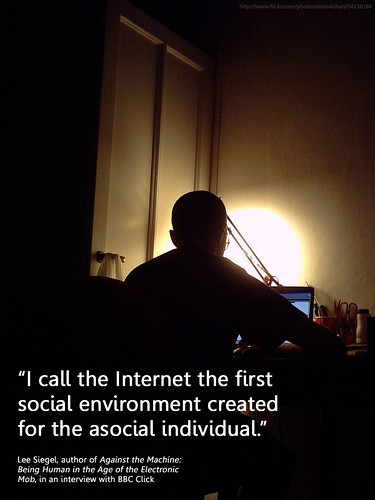
I was looking through flickr for some creative commons photos concerning social skills and stumbled upon this photo,
It’s well worth going over to Will Lion’s photostream and look at other of this work. Most of his graphics contain quotes, observations or statistics about media and culture.
My son just came in and told me a joke he heard on a science podcast.
“What is the difference between extroverted and introverted mathematicians? The extrovert looks at your shoes.”
23 March, 2010
Factual Credibility and Moral Expertise
Sam Harris TED Talk, “Science can answer moral questions” is eloquent to the ninth degree. He interweaves logical argument, irrefutable examples, and just enough humour so as not to appear arrogant or glib… what a delightful inspirational talk to watch over my early morning tea.
The real crux of his presentation occurs around sixteen minutes into his talk. He argues that in most scientific fields, we only listen to those scientists that posses credibility. Mr. Harris then says the following,
“Whenever we are talking about facts, certain opinions must be excluded. That is what it is to have a domain of expertise. That is what it is to have knowledge count. How have we convinced ourselves that in the moral sphere there is no such thing as moral expertise? Or, moral talent? Or, moral genius? How have we convinced ourselves that every opinion has to count? How have we convinced ourselves that every culture has a point of view on these subjects worth considering?”
This talk made me reflect over the last months of media coverage of political conservative dissidents and crazed Tea Party protesters in the battle to pass the US health care reform bill. I wonder how much of the essential good of the original bill (e.g. public option) had to be dismissed because too many voices lacking in factual clarity or moral expertise were heard. Why were these people given any credibility or such a large degree of coverage?
The real crux of his presentation occurs around sixteen minutes into his talk. He argues that in most scientific fields, we only listen to those scientists that posses credibility. Mr. Harris then says the following,
“Whenever we are talking about facts, certain opinions must be excluded. That is what it is to have a domain of expertise. That is what it is to have knowledge count. How have we convinced ourselves that in the moral sphere there is no such thing as moral expertise? Or, moral talent? Or, moral genius? How have we convinced ourselves that every opinion has to count? How have we convinced ourselves that every culture has a point of view on these subjects worth considering?”
This talk made me reflect over the last months of media coverage of political conservative dissidents and crazed Tea Party protesters in the battle to pass the US health care reform bill. I wonder how much of the essential good of the original bill (e.g. public option) had to be dismissed because too many voices lacking in factual clarity or moral expertise were heard. Why were these people given any credibility or such a large degree of coverage?
22 March, 2010
Everyday Heroes III
Everyday heroes we encounter are important influences on our lives. They have the ability to alter our thinking and, often, even the direction of our decision-making. This post is part of a series I am writing about the heroes I have met.

Name: Maria and Helmut
Profession: social worker, mathematician
Marital Status: married
Children: three daughters
Place of Origin: small villages in southern Germany
How we met:
Maria and Helmut moved into an apartment in the house where I was living when Maria was veryvery pregnant with their first daughter. The owner of the house was an eccentric landscape architect, whose offices and private residence were on the ground floor. I was living in the attic apartment. Maria and Helmut moved into the apartment on the second floor.
Maria and Helmut were the first “alternative” people I met in Erlangen, a politically conservative region of Germany. Alternatives, are people who are green, liberal, environmentally conscientious and politically engaged. Now, I may have been liberal, but more or less out from default: being young and having artistic leanings. I had no notion whatsoever about any of the other things. It took me quite a while to find out what those things were, because Maria and Helmut don’t talk much about their beliefs, they live them.
What changed my thinking:
These two people have shown me over the past three decades in the most mild and graceful way that social and political conviction is not ideology but a life practice.
Name: Maria and Helmut
Profession: social worker, mathematician
Marital Status: married
Children: three daughters
Place of Origin: small villages in southern Germany
How we met:
Maria and Helmut moved into an apartment in the house where I was living when Maria was veryvery pregnant with their first daughter. The owner of the house was an eccentric landscape architect, whose offices and private residence were on the ground floor. I was living in the attic apartment. Maria and Helmut moved into the apartment on the second floor.
Maria and Helmut were the first “alternative” people I met in Erlangen, a politically conservative region of Germany. Alternatives, are people who are green, liberal, environmentally conscientious and politically engaged. Now, I may have been liberal, but more or less out from default: being young and having artistic leanings. I had no notion whatsoever about any of the other things. It took me quite a while to find out what those things were, because Maria and Helmut don’t talk much about their beliefs, they live them.
What changed my thinking:
These two people have shown me over the past three decades in the most mild and graceful way that social and political conviction is not ideology but a life practice.
21 March, 2010
Everyday Heroes II
Everyday heroes we encounter are important influences on our lives. They have the ability to alter our thinking and, often, even the direction of our decision-making. This post is part of a series I am writing about the heroes I have met.

Name: Professor Wang
Profession: professor in the Electrical Engineering Department at the University of Waterloo, Ontario, Canada
Marital Status: married
Children: don’t know
Place of Origin: Mainland China
How we met:
Professor Wang never extended a cheerful greeting to any of his students when he encountered them outside the lecture hall. Unless you counted the clearing-his-throat greeting he occasionally extended as he walked pass, staring straight ahead. All of his students could imitate that particular clearing-his-throat sound perfectly. When Professor Wang gifted a student with it, the student was likely to speak in an awed voice recounting the momentous moment to others.
Students either loved or hated Professor Wang, whereas Professor Wang seemed to hold all students in complete indifference. Not in the sense he didn’t care, but in perfectly balanced neutrality.
It was said that Professor Wang discovered the transistor. (For those of you who don’t know what this component is, it represents the beginning of electronics.) Not as the Nobel Prize winner, but as the PhD student that did all of the legwork for the two professors who received the acclaim.
I took two of Professor Wang’s courses: Quantum Physics and Advance Laser Theory. Professor Wang’s teaching style was Zen-like in it’s simplicity. He would walk into the lecture hall with only a piece of chalk in his hand, write the last formula he wrote on the board in the previous lecture and then continue to fill the blackboard with endless mathematical arguments and extrapolation of physical phenomena.
What changed my choice of career:
Professor Wang was invited to spend a sabbatical in some think tank in the States. Upon his return, we asked him if he would give a lecture on his field of research. The next day he enters the lecture hall with his customary piece of chalk, as well as a large map of the human body’s meridian lines. To our surprise, he proceeded to give us a three-hour passionate lecture about “Chinese medicine and the future of western diagnostics”. After the lecture, I went and asked him where I could go to work in medical equipment engineering. He told me Germany.
Name: Professor Wang
Profession: professor in the Electrical Engineering Department at the University of Waterloo, Ontario, Canada
Marital Status: married
Children: don’t know
Place of Origin: Mainland China
How we met:
Professor Wang never extended a cheerful greeting to any of his students when he encountered them outside the lecture hall. Unless you counted the clearing-his-throat greeting he occasionally extended as he walked pass, staring straight ahead. All of his students could imitate that particular clearing-his-throat sound perfectly. When Professor Wang gifted a student with it, the student was likely to speak in an awed voice recounting the momentous moment to others.
Students either loved or hated Professor Wang, whereas Professor Wang seemed to hold all students in complete indifference. Not in the sense he didn’t care, but in perfectly balanced neutrality.
It was said that Professor Wang discovered the transistor. (For those of you who don’t know what this component is, it represents the beginning of electronics.) Not as the Nobel Prize winner, but as the PhD student that did all of the legwork for the two professors who received the acclaim.
I took two of Professor Wang’s courses: Quantum Physics and Advance Laser Theory. Professor Wang’s teaching style was Zen-like in it’s simplicity. He would walk into the lecture hall with only a piece of chalk in his hand, write the last formula he wrote on the board in the previous lecture and then continue to fill the blackboard with endless mathematical arguments and extrapolation of physical phenomena.
What changed my choice of career:
Professor Wang was invited to spend a sabbatical in some think tank in the States. Upon his return, we asked him if he would give a lecture on his field of research. The next day he enters the lecture hall with his customary piece of chalk, as well as a large map of the human body’s meridian lines. To our surprise, he proceeded to give us a three-hour passionate lecture about “Chinese medicine and the future of western diagnostics”. After the lecture, I went and asked him where I could go to work in medical equipment engineering. He told me Germany.
19 March, 2010
Everyday Heroes I
Everyday heroes we encounter are important influences on our lives. They have the ability to alter our thinking and, often, even the direction of our decision-making. This post is part of a series I am writing about the heroes I have met.

Name: Sandhya
Profession: mechanical engineer
Marital Status: married
Children: son and daughter
Place of Origin: Pune, India
How we met:
In 1985, a friend of mine asked me whether there was any possibility that I would take on a boarder from India for six months. Sandhya had been selected by a UN committee to be included in a group of 28 women engineers from various developing countries to go and do research at universities in England and Germany. Sandhya had arrived in Germany three weeks previous and was in misery. The university made arrangements for her to live in a student residence. She hadn’t had much to eat since she arrived because she could not face the general filth of the communal kitchen and the stink of the meat. My friend knew I was a vegetarian and so she hoped I would allow Sandhya to live with me until her contract was over and she returned to Pune.
The arrangement was that she would have my living room as a bedroom and we would share kitchen and bathroom. In my mind, it was just a practical solution to a bad situation. She was having a hard time adapting to the southern German love of meat in every form and manner. I had a room she could use. I wasn’t looking for friendship.
When I met her, we went through the guidelines of this arrangement: we’d each buy our own food, each person wash their own dishes, I liked to shower in the mornings if she could shower in the evenings, she could do laundry any time she wished, she could use the phone and just needed to keep a list of the calls she makes… It wasn’t a business arrangement (she wasn’t paying rent), but it was rather cut and dry.
The first evening she came back from working at the research institute she was loaded down with all sorts of groceries. After a perfunctory “how was your day” sort of conversation, I went into my bedroom to read and listen to music. In the next hour, all sorts of delightful aromas began to whiff under my door. A tentative knock, Sandhya asked whether I would like to share her dinner with her. I thought it would be rude not to do so on the first evening of her arrival, and accepted happily. It goes beyond my ability to describe how delectable the meal was.
This procedure happened the next night and the night after, at which time it became very apparent that Sandhya loved cooking, I loved eating, and we had endless topics to converse about.
How she changed my thinking:
Sandhya had a husband and small son back home (she had a daughter as well later on). Her parents were both teachers. She had had an arranged marriage. When I asked her whether she was happy with her marriage, she asked me to be more specific. So, I asked her if marriage had lived up to her expectations. At this, she laughed and laughed, and said it is better not to have any expectation about marriage, for they are bound to be disappointed. The expectations, not the person.
She told me that she truly thought there were no persons better to judge who she should marry than the people that loved her most on this earth- her parents. She couldn’t imagine any twenty-year-old having enough maturity or sense to chose properly someone for her to spend her whole future with. Also, even though she went into her arranged marriage with full acceptance, she knew that her children would marry for love. It wasn’t because she discounted the practice of arrange marriages, she just knew that her world was changing.
Sandhya showed me there was another world outside of the one I had experienced and the one portrayed by the media. She made me realise that love need not be the initiator for marriage, as long as it becomes the motivator to stay married. She also showed me that her blind trust in her parents ability to choose wisely, contradicted mine completely in my parents. I always resisted my mother’s vain attempts at matchmaking. These ranged from the lonely Scotsman who played his bagpipes at sunrise on the edge of the cliff outside my parents’ home, to a charming ne’re do well who said he worked for the US treasury, but everyone suspected he was a spy.
Subscribe to:
Posts (Atom)